On Clearing Out a Cellar
I recently assisted a friend who lost his father (Charles) in 2019. The late man's house is on the market and, although the ground and first floors have been smartened up, the two-room cellar was untouched until a month ago when the pair of us gave up our weekend and set about clearing it out. It's not something I would volunteer to do; I have to avoid provoking my nostalgic streak. Only the call of a good mate who's struggling with the absence of his father - and pressed for time - is persuasive enough on occasions like this. We both knew that it was going to be a bit grim.
Charles lost his wife over a decade ago and much of her stuff was moved down to the cellar. I'm sure this was for the three most natural reasons imaginable; his being too distressed by the loss to deal with it but, simultaneously, wanting it out of immediate sight allied to the strange sense of guilt that can sweep over a person when he considers divesting himself of a deceased partner's effects.
Of course, any adult who has had to do this kind of sort out, and is any more than the least sentimental, knows how emotional it can be looking at stuff that is old, broken, dishevelled, mouldy or yellowing with age but doing so in the knowledge that the stuff meant something to somebody. And, of course, it's much worse if the person was dear to you.
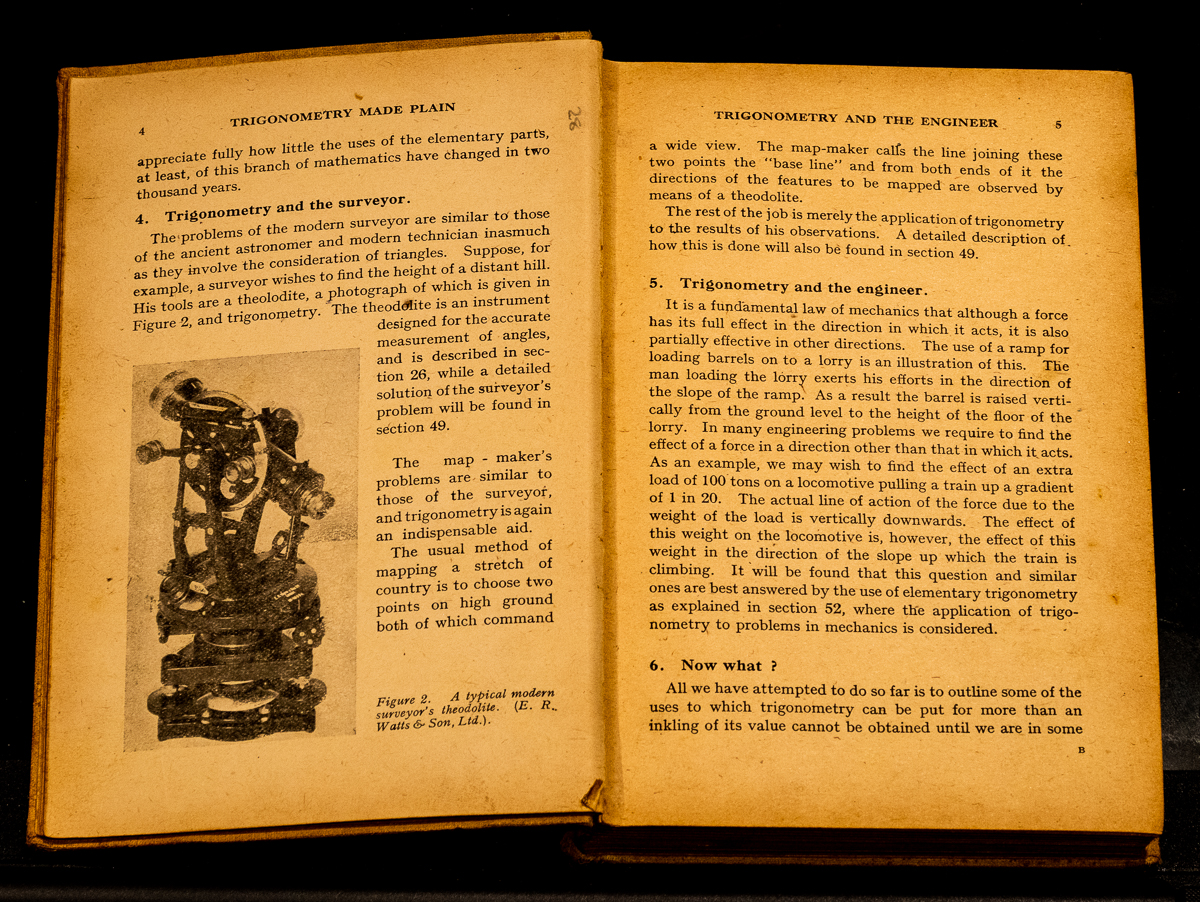
Though not a country pile, Charles's house is a large property; converted from a former private school boarding house. The main downstairs rooms are generously proportioned and speak both of a successful life and an enquiring mind. The house immediately presents itself as that of an old person but not because of decay; simply because his tastes were of his time (and before). And how quickly fashion and design look utterly dated! My father is of Charles's generation and the book in the picture was newly published when my father bought it in 1949. No doubt it looked as up-to-date and desirable as any text book on trigonometry could(!). Now it might as well be a piece of Victoriana. Such is the case with many of Charles's possessions. They are perfectly functional - better than that, in fact, because they are items of quality - and not falling apart but they say 'old' to you.
The heating has not been fully employed recently and it shows. Madonna had a point when she complained about English houses in the 1990s. She said something like "What is the matter with British property? All your real estate is damp." Certainly any pre-1990s house situated west of Salisbury plain needs to be kept warm and dry if it's going to be hospitable. Whether we like it or not, the western half of England is damp damp damp. Charles's cellar had no means of heating at all.
I was slightly dreading the cellar; not just the emotions that come from confronting someone else's personal effects but that clinging, close air and lung-hassling, spore-laden dust that blooms and clouds and assaults you whenever a box is lifted up or things get disturbed. I brought a dehumidifier with me and set it on 'high' but over the course of that weekend it didn't have the time to really make a difference.
Descending below ground the air was everything I expected and Charles had made the classic error of storing things on the flagstone floor. Off the ground, on slatted shelves, things can survive surprisingly well, even in a Somerset cellar, but being propped against a wall or left on the ground itself will destroy most organically based material including fabrics, paper, and cardboard. It's damp and bloody cold. The cardboard boxes on the ground disintegrated with the first attempt at picking them up, leaving the bottom and contents on the floor in damp-darkened piles while the sides came away in my hands. Some of my friend's and his brother's school books were there, filled with the characteristic writing of the junior school child. Numerous toy tanks, cars and artillery pieces fell out of flimsy containers along with yellowed newspapers and magazines. And then there was the fabric; metre upon metre of it, stuffed into bags so tightly that the damp air could not circulate within, oddly enough affording the material some protection. In one corner, on a bottom shelf and on the floor were some original artworks of no particular provenance, which Charles had inherited from an aunt. Most were so wrecked by mould assault that they departed their frames at the first attempt to lift them. As Saturday wore on I was left with the feeling that, much as the cellar had been a window into someone's past, it had also been an object lesson in the consequences of storing anything but wine or bricks underground. Even stainless steel items were pock-marked with rust.
What did survive undamaged, of course, was glassware and china. Little keepsakes, holiday mementos, ornaments and so on. In some senses the least personal items of the lot. Photographs, papers, books, paintings all yield to time and climate (a roll full of 35mm negatives was lost; the emulsion having left its plastic base) but mugs, bottles, teapots, trinkets par excellence, they stand the test of time.
Sunday was much as Saturday had been, with trips to the local recycling centre and a long session at a local storage facility to finish the day. It's difficult not to succumb to sentimentality, even shifting stuff belonging to someone you've never met, and I finished the weekend feeling a bit forlorn but, simultaneously, my resolve that I will not leave a disordered heap for my children to sort out has become harder than ever. Minimalism has become a friend to me and I'm now curious to find out just how little I need.