James Roden Austin 1934 - 2022
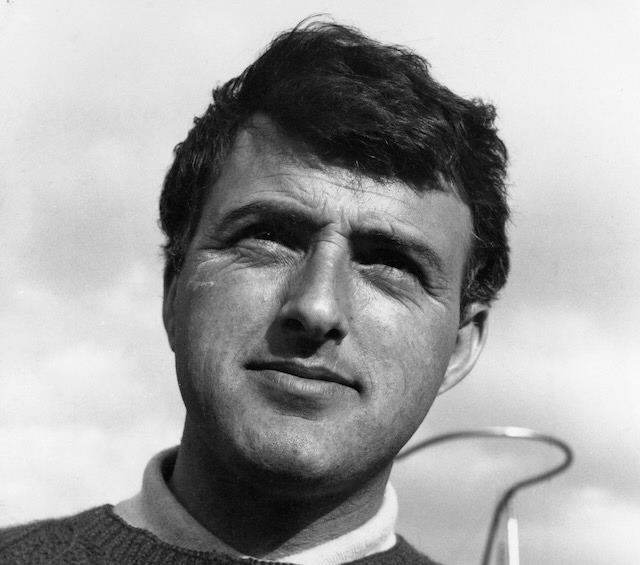
This is an extended version of the eulogy I wrote for my father and which I gave at his funeral last Monday. I’m putting this up because some of you will be aware of the difficulties I had with him, especially in his final years. Those difficulties may have left a very limited sense of this remarkable man. It’s important to me to redress that. It's not well written, but grief hasn't produced coherence.
We played him in with 'The Pearl Fishers' duet (Bjoerling/Merrill) and we played him out with Tommy Dorsey's rendition of 'I'm Getting Sentimental Over You':
We will all have time to reflect in the coming months and years on our own experience of knowing Dad; Jim Austin. Right now, I would like to say a few words about the man himself and what he stood for.
Born in September 1934 into a home devoid of any privilege, he had a rather rough and tumble childhood. He had friends at school with rickets and others with obvious congenital defects. At the age of five he was hospitalised with a middle ear infection that became mastoiditis. Alone, with Britain at war and his home town being regularly strafed by the Luftwaffe, this illness was a very frightening experience, and one from which he never fully recovered. Antibiotics were not available so it was necessary to remove a section of bone from behind his ear. This experienced traumatised him to such an extent that he remained hospital phobic to the end of his days which, ultimately, contributed to his demise, as his refusal to get his knee joints replaced until it was too late left him chairbound and set off the process of multi-organ atrophy that ultimately killed him.
Childhood play was centred around the beach, boats etc and Dad developed the great yearning for the sea that dominated the first half of his life. Teignmouth being a target for the Germans during the war, he was evacuated to Abbotskerswell where his aunt Greta ‘looked after’ him. A cruel, clever woman - for the time too smart (and slighted in love) - she did not treat him well and he made more than one attempt to run away. On one occasion he almost made it back to Teignmouth but was picked up by an adult who recognised him and returned to his tormentor. When she died in the early 1980s he refused to attend her funeral, causing enormous distress to his mother, but he would not budge, standing firm, as he would repeatedly on points of principle despite verbal (and physical) assaults on occasion.
His father fled the family home in 1944 leaving a shocked wife, Dad, aged 10 and his younger brother John, just five. He never heard from him again. One can only be thankful not to have endured such an experience.
By his mid teens he was a strong swimmer; strong enough to swim from Teignmouth to Dawlish. He had known since his early teens that his future lay at sea and at the age of 15 he left home to train for the merchant service at the Thames Nautical Training College at Greenwich. He was an excellent student and shortly after leaving he secured employment with Houlder Brothers shipping line. Within a short time he had his Mate’s Foreign Going Certificate from the Board of Trade and could navigate a large ship anywhere around the World (excluding complex inland waterways where specialist pilots had to be employed). In 1961, at the age of just 26, he was given the position of navigating officer on the SS Duquesa, the largest refrigerated cargo ship in the World.
He met his future wife, Valerie, in 1957 at a dance on Teignmouth Pier. They were married in 1960 and in 1961 he left the merchant navy to come ashore. He found work as the lowest grade of clerk in the Air Ministry and he trained at night school for an HNC in civil engineering. While doing this he also obtained his private pilot’s licence and returned to his pre-navy hobby of shooting. Where he had previously used an air gun he now had a .22 subsonic rifle and he excelled, becoming the county champion and winning selection for England. He represented his country at both rifle and pistol and his favourite discipline was ‘free pistol’ where 60 shots must be made in 2½ hours. Competitors train themselves to control their breathing and their heart rates to ensure optimum stability in the gun. Accuracy is everything. He missed selection for the 1972 Olympic Squad by one point.
Back to his career: his HNC led to employment in the county highways department as an assistant engineer - a ‘civil engineering technician’. He surveyed roads and designed road improvements, some of which involved major works (co-design of Haldon Hill near Exeter being one such example). He was renowned for the accuracy of his work. It is no exaggeration to say that he commanded enormous respect from his colleagues. The senior engineer in his team remained a friend right up to his death. He wrote ground-breaking civil engineering programmes that exploited the capabilities of the simplest programmable calculators then later the most primitive home computers. He also wrote spherical astronomy programmes for the same machines, well in advance of any being available commercially.
By 1970 he was the father of three boys and he wanted them to grow up in West Cornwall, near the sea and away from any major urban conurbation. In 1973 he made the move, buying the house near Truro in which he would die 49 years later.
He took up clay pigeon shooting and within a matter of months was runner up in the county. Many years later, in his latter ‘60s, having returned to the hobby after an extended lay-off, he was runner up again. At the age of 41 he took up squash and within a few weeks was beating far more experienced players ten years his junior. He would return home, beetroot red and drenched with sweat, slump into his usual kitchen chair and discuss the match with Mum (sometimes with a can of lager in hand) before going upstairs for his shower. In his latter ‘40s his hobby was archery and at his second tournament he won the prize for the most concentric gold (bullseye). He could also identify any native British bird almost instantaneously though occasionally he would have to reach for his Zeiss binoculars!
As a parent he maintained quite a disciplined household. This was from a genuine belief that ill-disciplined children turned into problematic, wayward adults. He was, in that sense, truly old school and it was probably not until 1990, when two of his sons had long hair, that he finally realised that a man with long hair is not necessarily a feckless layabout! Discipline was there because conduct mattered to him; how you treated other people, how you behaved, was important. But it was not important because of any sense of deference to any external authority; it was important because it was just right. In fact deference had no place for him whatsoever: rank, position, title mattered not a jot and he could be fiercely abrasive to the pompous.
He was generous at the right times and he clocked up thousands of miles ferrying us about to our various hobbies, which he was keen to see involved the right expert tuition. He loved the trombone. He's the reason I'm a trombonist. When cricket obsession took hold of me in the early 1980s he joined in and dusted off a handy slow-medium bowling technique that proved successful over several seasons of club cricket.
The Austin home was free of any religious or political dogma. All ideas were open to discussion provided they could be justified and backed up. He loved picking apart flimsy claims and statements and from early on as a parent he would engage us in heated discussions about what we had heard at school, why we believed it and where the original justification was for it. It was a training in critical thinking that went on week-in-week-out for years. Ideas had to be unpicked, qualified, severely tested. It was the absolute opposite of living in the world of an encapsulated, self-referencing belief system. This was nothing short of an extraordinary gift to his children. Critical thinking is in desperately short supply.
He had recordings of the speeches of Dr Martin Luther King and he made me listen to them. He wanted me to understand the struggle that certain groups have had, to lead decent lives.
He taught us that quality is important and to buy the best one can afford and look after it. I wrote the first draft of this with the Sheaffer 'Valiant' fountain pen that he bought on shore leave in New York in 1958. "Look after your kit!" is a phrase my children know very well...
Although deeply rational he was way ahead of the 'alternative' curve in some respects, exploring esoteric knowledge when the only people doing it were ‘new age’ types or eccentrics. He had books on Stonehenge, on ley lines, on dowsing and on alternative energies and he read them properly, as he did every book he owned, with concentration; from cover to cover. He loved books and drilled into us in the most beneficial way that, if one wanted to know something, one should find the authoritative books on the subject and read them all the way through. He revered books as coherent bodies of knowledge that one should read, fully understand, and only then move on from, perhaps looking for alternative viewpoints once one held sufficient knowledge about the core of the subject.
In 1952 he had contemplated getting employment on a whaling ship but not long afterwards began a philosophical journey that led to his becoming a member of Greenpeace and he actually applied for the job of navigating officer on Greenpeace’s vessel Rainbow Warrior in the early 1980s. He was willing to put himself in harm's way to stop what he saw as an absolutely abominable activity.
The dramatist and script writer Paul Billings was a close friend and he observed that everything Dad touched had the sparkle of excellence. He spent his life in the pursuit of excellence and he didn’t stop thinking, learning, exploring until he was very immobile.
I don't want to recall Dad’s final years. After Mum died, he lost his anchor and became an increasingly distant and difficult parent and an almost irrelevant grandparent. Even in his peak years he could be an infuriatingly distant man but those who knew him at his best - as colleagues, as friends and often as his children, knew that he could be a great guy. I want to remember the curious intellectual, the reader of bedtime stories, the comedian, the father as template for maturity, the true freethinker. All those things no words can do justice to.
There is a Hebrew proverb that states “Say not in grief that he is no more but in thankfulness that he ever was”. Albert Einstein said everything is vibrational energy, some of which we can see and hear and touch. Dad's vibrational energy has left us now.
Farewell Dad, and thanks for all the good stuff.