The End of Throw-Away Culture?
Back when I was still a schoolboy, I was visiting my grandmother and made the mistake of 'swinging' on one of her old wooden dining chairs, that is tipping the chair back onto its rear legs while sitting in it. She was onto me like a flash, explaining that the chair would break and that she and her late husband had spent over £3 on each of the chairs when they were purchased in the 1930s. That was a week's wages for many and these chairs (dark wood with barley-twist legs and red upholstery) had clearly repaid the outlay; there was no looseness in the joints and they barely creaked, despite 50 years' use.
Do any of us expect a dining chair to last that long? There are certainly artisans around who can build a very durable chair for a week's wages but we've been conditioned (not all of us totally and a few hardly at all - I accept that) to see many household items as things we can purchase cheaply (and on credit), get a few years out of and then throw away; replacing such items with something similarly inexpensive. This way of acquiring items for one's home achieved general acceptance, except in the minds of a few determined folks (early eco-warriors, quality freaks, sage observers etc) by the 1970s and held sway until the 1990s, but the tide has slowly been turning since then.
There is a general acceptance now that we cannot continue to bury our waste indefinitely and millions know about the ghastly problem of marine plastic pollution as it was illustrated, with great impact, by David Attenborough in Blue Planet. Nonetheless, most of us continue to chuck stuff away while hoping that a solution to the landfill problem will somehow materialise, maybe through a scientific breakthrough. I live alone and it takes me three months to fill my dustbin but it still bothers me that I am filling it at all. We can blame polystyrene packaging, non-recyclable plastic wrapping and various other things but the issue is tied to our own decisions: Comedian and philosopher Alexei Sayle expressed the problem brilliantly over fifteen years ago, in a documentary, of sorts. He said something like this: "We can go in for this or that green initiative with re-using, recycling or whatever but we will never deal with the waste problem until we get out of the mindset that we need to keep buying all this shit." A recent Facebook post added another 'layer' to this sentiment, stating: "Look around you: All that clutter used to be money. All that money used to be time". At the end of the day, everything we possess is either an ornament or a tool. If it's an ornament that is not appreciated for its aesthetics or a tool that is not employed for its functionality, it's just clutter.
Industrial research to find ever more efficient ways of doing things is valuable but the notion that the emergence of a new product requires us to dispose of an old one is not. The fashion industry is another case in point; reliant on continually persuading enough people that their look is yesterday's look. It's nonsense: I think it was the great dress designer Jean Muir who said "to be in fashion is to be out of style" and Oscar Wilde noted that "Fashion is a form of ugliness so intolerable that we have to alter it every six months".
After the Second World War an industrial movement emerged promoting disposability - the throwaway culture, whatever you may wish to call it and, with the aid of the advertising industry, it successfully persuaded the inhabitants of Western nations to behave in a way that was expensive for them and bad for the planet. Vance Packard described it in his book The Waste Makers. We can carry on the blame game but it's pointless now. Here are some thoughts. I find them, cumulatively, to be encouraging and hopefully others might feel the same:
One can break the buying cycle: All through my twenties and thirties I wanted 'stuff'; an Omega Seamaster chronometer, a Leica R6 camera, an Aston Martin, a Mont Blanc Meisterstuck. It took me until middle age to understand that by far the most fulfilling things are interesting experiences, especially in the company of nice people. I have a dear friend who, being hyper-sensitive, melancholy and unfulfilled, just keeps buying more things in the hope that the next purchase will scratch that itch. It never will, my friend knows that, but carries on buying anyway. There's a real danger that your things end up 'owning you' and not vice versa. We can kill this acquisition thought-demon. It takes a while - sometimes years - but a massive tidy-up and turn-out followed by repeated trips to the charity shop can be cathartic and it is possible to experience real pleasure in newly created space. I've got a few hundred books and I love books (and, unlike the internet, good reference books offer a coherent body of knowledge with no distracting links to send you off-piste), but it's 'one-in-one-out' with them now and the shelves are not overflowing. It works with the wardrobe too.
Most white goods (and many other items of equipment) are built with a life expectancy of five to ten years but some - albeit three times as expensive - are built to endure many, many years of heavy use. "Buy cheap; buy twice!" as my middle brother likes to say, or dig deep and buy something to last. The choice is ours. The managers of landfill sites will be grateful if we go with the latter option. A recently retired publican told me that he owned a German washing machine (that would cost about £1,500 to replace now) that had coped with a 90-degree chefs' whites wash five times, every week for twenty-one years.
Go for design quality (functionality as well as appearance) over newness and novelty. My friend Matthew Duguid is a high-end set designer who has worked with many of the World's top fashion / portrait photographers. He has a massive collection of props, and has started a new venture; giving a new lease of life to many of the beautiful and functional items he has acquired for his work. He understands that a well-made and aesthetically pleasing item remains so, even if it is no longer the latest thing (and how long does anything remain 'the latest thing', really?). Many of us have the capacity to appreciate items with an enduring design aesthetic and one could also argue that buying new when we could buy 'vintage' is eco-vandalism. Most of the small companies that manufacture climbing equipment were founded by climbers. In the climbing world everything works really well because when you are halfway up a rock face you will not tolerate any kit that is not ergonomic and fit for purpose, so such stuff hardly ever makes it to the production stage because the designers and users are the same people (or work hand-in-hand) but people engaged in non-life-threatening tasks are expected to put up with shoddy design, unreliability and poor durability because of the 'that’ll do' mindset that seems to infect some of those who design household equipment.
Alone we will make little impact but the combined spending decisions of millions of concerned individuals are powerful enough to change corporate behaviour (and potentially help thousands of small businesses trying to do the right thing).
Although this is very slightly off-topic it's worth mentioning that there's a movement underway in the fashion world - 'pre-loved designer' and 'vintage designer'. Rather than used garments being seen as charity shop items for those on a tight budget, they may now also be perceived as couture bargains. It was stated last year that if everyone bought a pre-owned garment at Christmas, rather than new, it would be the equivalent of taking 56 million cars off the road for one day. There's an article about this here.
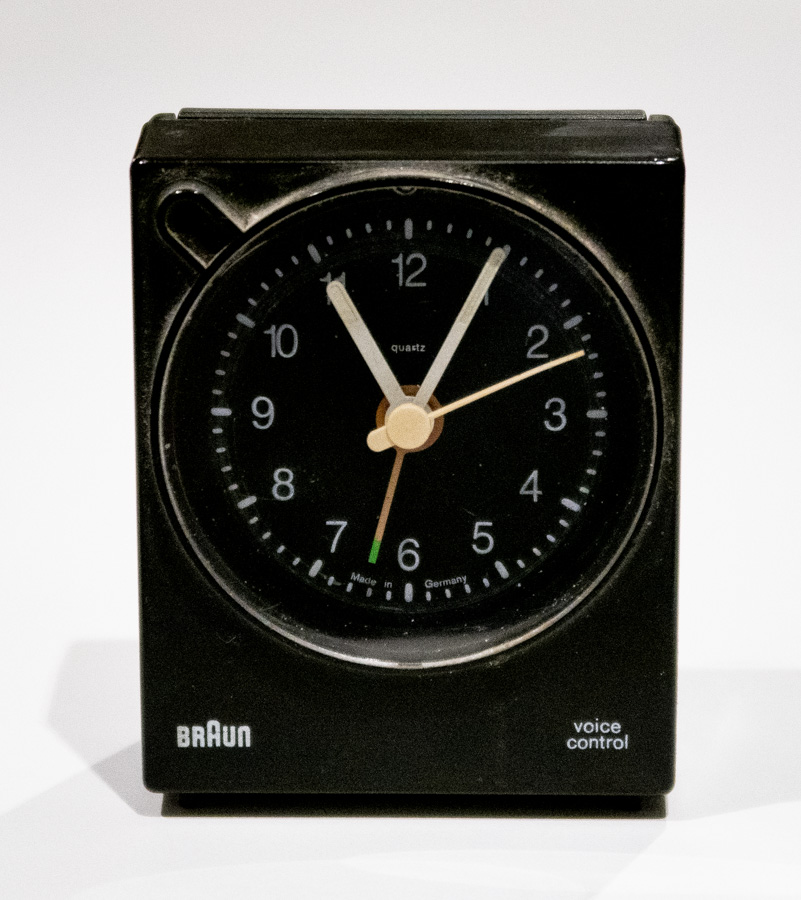
In the photo is my Braun alarm clock, designed by the legendary Dieter Rams (inspiration to Jonathan Ive, Apple's head of design). In a nice reconnection with the opening of this piece, it was a gift from the grandmother with the barley twist chairs and I've had it for 34 years. It's been knocked off the bedside table by the flailing hands of its just-awake owner more times than I care to recount but it just keeps going. Braun understood the potential for it to take a tumble and went to the trouble of giving it shock-proof circuitry.
Here's my attempt to come up with some design rules that no sensible person would argue with:
- It must do what it's supposed to with the least possible effort for the operator
- It should be built of components that will ensure it continues functioning for many years
- It should be made of recyclable or biodegradable materials if they will suffice
- It should be as small as practicable
- It should look as good as it's function permits
P.S. New York Times, 23rd October 2020: https://www.nytimes.com/2020/10/23/climate/right-to-repair.html?utm_source=pocket-newtab-global-en-GB